
A Year to Build Power
by Melissa Everett, Ph.D.
January 21, 2026
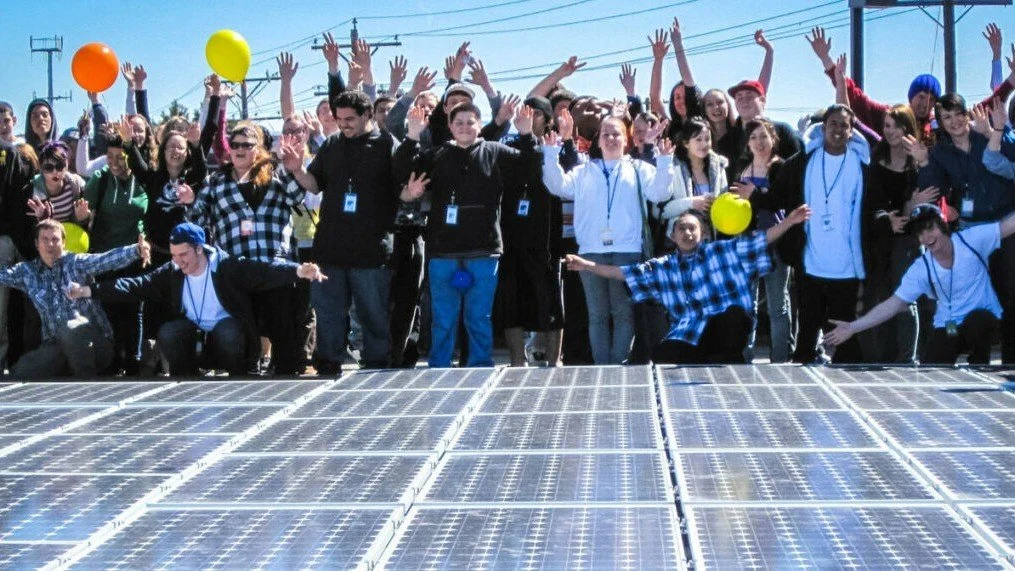
Copyright: CC BY Marnee Benson
The year 2026 has begun with gale-force headwinds against clean energy and climate action, from the federal intervention in Venezuela and offshore wind work stoppages, to the New York Governor’s shifts in energy policy. Challenging these developments directly connects the energy transition with democratic resurgence. As Bill McKibben writes in Here Comes the Sun, “Solar is the new peace sign.” If you understand that climate change is not going away and you are part of the groundswell for a livable future, getting solar panels onto rooftops and parking lots and closed landfills in your community is an act of self-determination and an assertion of values. It’s also a way for individuals, businesses and communities to own energy assets. Read on for the why and how.
To advance this agenda, Sustainable Hudson Valley will be amping up our focus on authentic education and community engagement so that communities can chart their own energy pathways and learn from each other.
We are thrilled to announce that we’ve received a two-year grant from the New York Community Trust to provide high quality public education on solar power and battery storage, so that communities can decide where and how to deploy them and say “YES in my back yard.” As federal incentives for renewable energy end and critical offshore wind projects have been senselessly stalled, we are leaning into supporting climate solutions at the regional scale through community led planning. For those of us who are still proudly all in on building climate solutions, this is our moment to lead with values.
The year starts with publication of the Clean Power Guide, a consumer-empowering publication, with Chronogram Media. We're launching with a free panel of experts who can coach homeowners on renewable technologies - January 28, 2026 from 5:30 - 7:30 at the Fuller Building, 45 Pine Grove in Kingston. Come learn and network.
We are also planning a new round of Solarize programming for customer education in partnership with trusted installers. We were a leader in opening up the solar marketplace ten years ago using this model, a combination of group purchase discounts negotiated with trusted installers, along with extensive community education and participation. We had library meetups, parade floats, a solar chorus. This fun brought people together to learn about the technology and cheer each other on, leading to 400 more roofs with panels and many connections that last to this day. While the market is more mature, the opportunity remains for people-power to reduce soft costs, as Sustainable Westchester has done with an ongoing program.
These projects will test out a thesis, that the missing element in New York’s energy transition is community: people connecting with each other to make sense of radically new ideas and technologies, and determining the path forward for their communities.
Consider: solar technology is no longer “alternative.” It is a commodity whose price is falling fast, making it widely affordable even without federal subsidies. Solar systems pay for themselves well before the end of their operations, and then generate economic benefits thanks to state incentives, well developed financing sources, and a widening range of ways to deploy solar as a mainstream power source. For example, the recently formed Municipal Solar Partners is fast-tracking municipally owned projects by providing private funding for engineering studies and site preparation.
Affordable ways to go solar are proliferating. An example is those cool, plug-in balcony solar units all over Europe that aren’t even connected to the grid – solar as appliance. But there is a wrinkle. Plug-in solar systems are not legal in New York. There is a bill before the legislature this year, the SUNNY Act, that would change that and open up a new world of ownership possibilities.
More broadly, getting to yes for solar and storage is going to require new approaches to planning and local policy. McKibben points out that home solar systems in the UK and Australia cost about 1/3 what they do in the U.S.; the difference is “soft costs” such as getting permits and customer education. Some of our communities already have streamlined solar permitting, and we’re here to support others on that path.
It is time for an entirely new level of community involvement to guide the energy transition so that we put the solar panels where communities want them and minimize painful conflicts. New York has been slipping in meeting its legal requirements for scaling up renewable energy, and now expects to achieve 2030 commitments about six years later. Informed and motivated communities are our best lever for changing that.
The newly adopted state energy plan actually takes us in the wrong direction. It replaces focused commitment to renewables with an “all of the above” vision of more, more, more supply, even from polluting sources like gas and nuclear power. The common story line in the mainstream press is:
1. Energy costs are rising.
2. It’s somehow connected with investments in upgrading the grid for renewables.
3. So let’s soften our commitment to renewables, build more conventional energy and stop worrying about blackouts or price spikes.
This is backwards. Upgrading the grid is not optional. It is necessary - because the power grid is antiquated and already stressed. Spiraling demand for power, driven partly by data centers, has forced this recognition to the center of public awareness. But there is no basis for blaming renewables. Especially when combined with efficiency and storage, they offer a path to stability of both grid and local economies through community and business ownership of local energy assets. According to a new study, Sunlight Into Savings: Evaluating Energy Cost Savings from Distributed Solar and Storage Additions in New York, distributed solar combined with energy storage will stabilize energy prices, actually reducing average energy bills upstate by $87 and downstate by $46 a year, for accumulated savings of $1B a year.
One of the biggest challenges to building large-scale solar systems is the disconnect between community land-use planning and the utilities’ planning to upgrade the distribution grid. This disconnect is why so many solar farms are proposed in places where people don’t want them, but where the grid can support them. It’s smart local zoning to prioritize solar installations on closed landfills, big commercial rooftops, airports and campuses and other already developed land – protecting farms and forests and historic districts, or making smart use of integrated approaches such as agri-voltaics. But those locations may not have the “headroom” on the grid for a new solar farm, or be in the utilities’ plans for upgrading any time soon. There is a new approach to bringing generating capacity onto the grid, called flexible interconnection, which can cut costs by up to 75% and is being piloted by utilities around the country. As communities in the Hudson Valley take a more active role in determining where they do want to put solar installations, our utilities have a clear opportunity to innovate and build good will.
When it comes to climate progress, three very different futures are possible.
1. State leadership could be restored to implement the Climate Law.
2. The law could actually be rolled back.
3. Communities and local leaders in New York could step up and set local priorities for the energy transition, siting solar arrays where they have public support and working with the utilities to get the grid into shape to make it work.
We have the tools to course-correct and close the gap in meeting our renewable energy goals, and everything to gain in doing so. The strategy starts with bringing people together. Let’s do this.